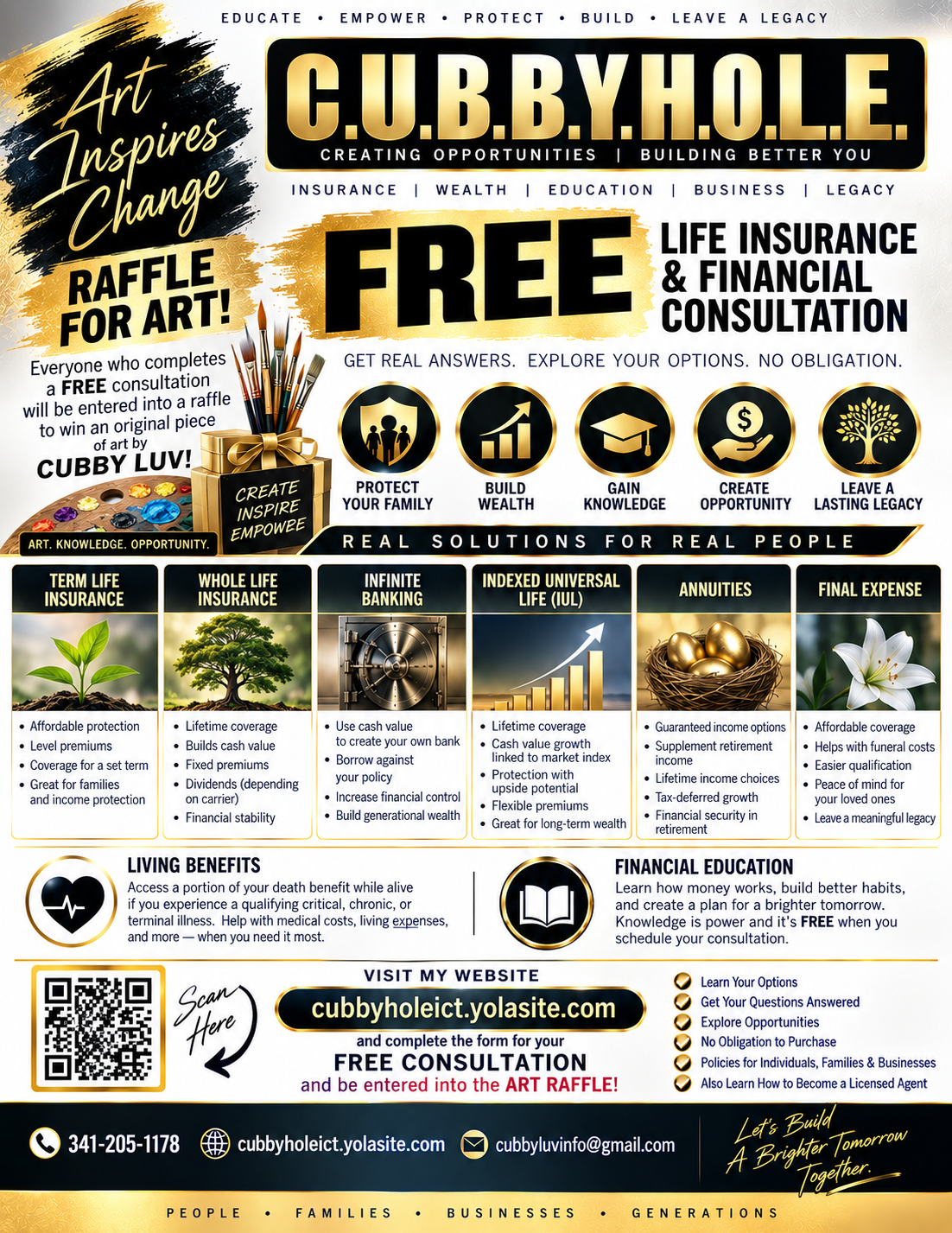
πŸ“£ SHOUT OUT TO DREAM C.U.B.B.Y.H.O.L.E.  πŸ“£

Where dreams, purpose, insurance, media, communication, education, and opportunity come together!

We’re building more than a businessβ€”we’re building a platform designed to help people dream bigger, protect what matters, develop their talents, and create opportunities for themselves and their families.

πŸŽ™οΈ Media & Communications
πŸ›‘οΈ Life Insurance & Financial Protection
πŸŽ“ Education & Training
🀝 Leadership & Agent Development
πŸ“± Digital Media & Content Creation

Dream it. Build it. Protect it. Communicate it. Live it.

πŸ”₯ Dream C.U.B.B.Y.H.O.L.E. β€” the vision is bigger than the name!

B KING'S JOURNEY

CUBBYHOLE ICT DIGITAL POP-UP GALLERY
Business β€’ Art β€’ Financial Education β€’ Legacy

Help us discover what motivates your journey. Complete this free 20-question survey to share your interests and future business goals.

0 of 20 questions answered
01 β€” Your Motivation

Prospect Information

Your contact information is requested so we can identify your submission and respond as permitted.

Privacy & Participation Disclaimer

Participation in this survey is voluntary and free. Completing this survey does not obligate you to purchase artwork, insurance, financial services, or any other product or service.

Cubbyhole ICT collects the name, phone number, email address, and survey responses you choose to provide. Your information will be processed through Formspree for survey administration and communication you authorize.

We will not use your information for unrelated marketing without your permission. We will not sell your contact information. Survey responses may be analyzed in aggregate to improve our programs and business opportunities.

No Social Security number, financial account number, or other sensitive identification information is requested. You may request deletion of your information by emailing cubbyluvinfo@gmail.com, subject to applicable retention obligations.

Completing this survey does not automatically enter you into an art raffle. Any raffle will have separate official rules and entry requirements.

An everyday side hustle is an idea you decide to put to work. It may be a service you offer after your regular job, a product you develop while looking for work, or a new offer you add to a business you already own. The point is to start with what you know, notice a need, and test whether you can create something people value enough to pay for.

That sounds simple until you have to make decisions. Who exactly is this for? What problem does it solve? How much will it cost to create? What should you charge? Where will customers find you? This glossary gives names to those questions. The words are tools, and each one helps you see a different part of the business you are building.

Brainstorming helps you bring ideas into the open. Market research and competitor research help you find out what people need and what choices they already have. A customer avatar and target market help you focus on the people most likely to benefit. Your offer and value proposition explain what you provide and why someone might choose it. A call to action tells an interested person how to take the next step. Those terms turn a thought in your head into something another person can understand.

The numbers matter just as much as the message. Startup costs tell you what you need to begin. Expenses show what it takes to keep delivering. Price, revenue, profit, and break-even point show whether your idea can support itself. A sales forecast is a goal to test, not a promise. Knowing these terms helps you ask better questions before you spend money, set a price, or count on income that has not arrived.

You also need a way to learn as you go. A scorecard helps you compare ideas. A workflow helps you repeat the work. Customer touchpoints and purchasing objections show where people connect, hesitate, or leave. Seasonality reminds you that demand may change. Feasibility asks whether your idea fits your actual time, resources, and life. None of this requires you to have everything figured out on day one. It gives you a way to pay attention and improve.

That is why this glossary is important. It gives beginners a shared language for decisions that can otherwise feel overwhelming. If you already have a business, it helps you examine the next product or service with fresh eyes. If you are between jobs, it helps you turn available time into focused experiments. If you are employed, it helps you build carefully around your responsibilities.

A side hustle is built through actions you can test: listen, create, offer, measure, adjust. These terms help you understand what happened at each step. They cannot guarantee income, but they can help you replace guessing with questions, and questions with a plan you can work. Follow each term back to a decision you must make, and the glossary becomes a map for building with purpose, patience, and evidence from experience.